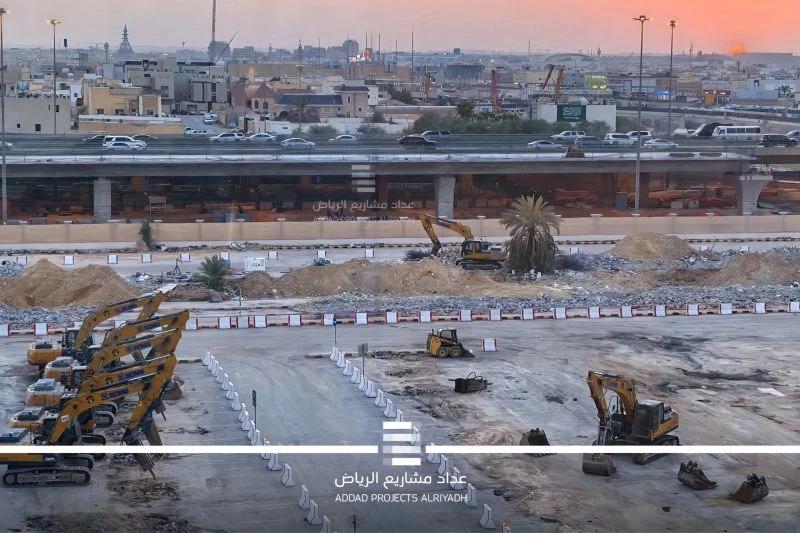
Published 9 November 2026 · 2 min read
Riyadh’s arterial and ring road expansion programs frequently require clearing conflicting buildings, commercial plots and municipal facilities that lie directly in the path of new carriageways and major interchanges. Executing structural demolition along active road corridors presents unique operational constraints compared to open-plot projects: heavy equipment operates metres from continuous traffic, over dense underground utility networks, and under intensive municipal surveillance targeting dust violations.
Prepared by Bariq Arabia, a Riyadh contractor and manufacturer certified to ISO 9001, 14001 and 45001, from the official sources and our work on site.
Based on: Balady Portal — Commercial Building & Facility Demolition Licence · Riyadh Municipality — Urban Road & Corridor Construction Guidelines
1. Utility isolation, expropriation lines and pre-demolition survey
Before bringing heavy excavators on site, the right-of-way boundaries must be verified against municipal cadastral plans to ensure neighbouring buildings outside the project scope remain undisturbed.
Official utility clearances (electricity, water, telecommunications networks) are coordinated with service authorities to fully isolate incoming feeds. Underground survey crews map live high-voltage cables and fibre-optic conduits running adjacent to the roadway to prevent catastrophic service cuts.
- Verification of the expropriation boundary against official road development plans.
- Documented disconnection and clearance certificates from SEC and NWC.
- Pre-condition surveys and crack monitoring of neighbouring structures adjacent to the demolition zone.
- Ground-penetrating radar (GPR) scans for unmapped underground utilities along the site perimeter.
2. Perimeter security, traffic management and deep shoring
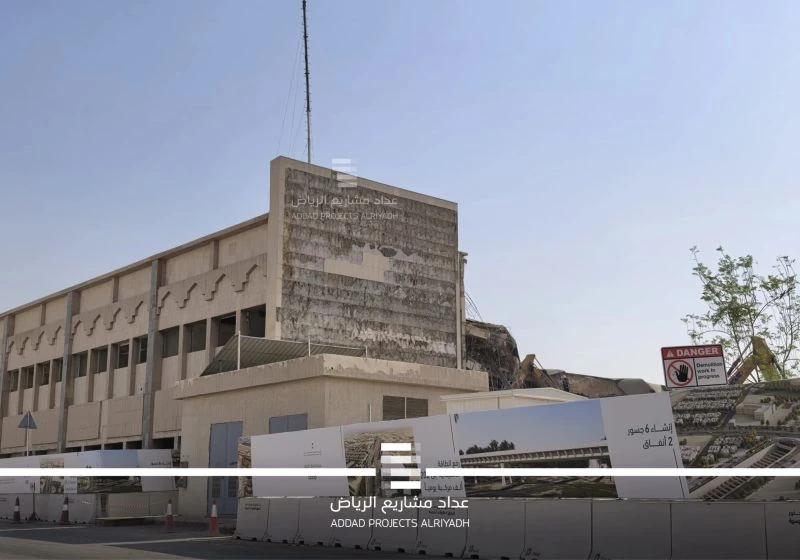
Urban road projects cannot shut down major corridors during daytime hours. Site perimeters require heavy precast New Jersey concrete barriers paired with engineered hoarding panels compliant with Riyadh Municipality specifications.
Where road widening requires lowering grades or excavating adjacent to live traffic lanes, contiguous or secant piling, soldier piles, or temporary steel shoring must be deployed before structural demolition begins to prevent road shoulder subsidence.
3. Environmental compliance and dust suppression standards
Environmental inspections in Riyadh enforce strict penalties on uncontained construction and demolition dust, with single violations reaching substantial fines. On road corridors, airborne dust poses an immediate traffic visibility hazard.
Standard compliance requires dedicated high-pressure water misting cannons operating continuously at the excavator breaker or shearing point, combined with full canvas truck covers before any vehicle enters public streets.
4. Material segregation, rubble clearance and certified dumping
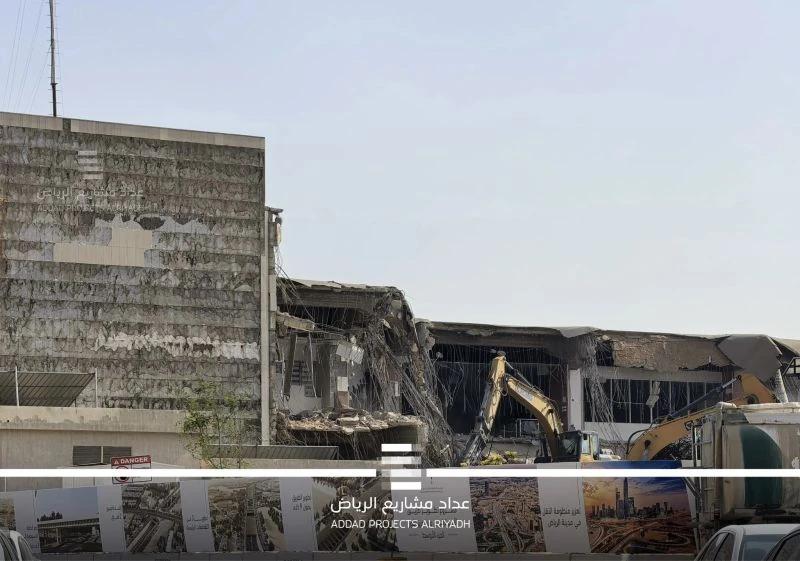
Efficient demolition relies on fast turnaround cycles. Structural concrete is processed and separated from reinforcing rebar on site. Scrap steel is bundled for recovery, reducing the total volume of inert waste transported.
All concrete rubble and excavated soils must be hauled by licensed transport contractors to certified municipal dumps and recycling facilities (such as SIRC facilities), with electronic manifest tracking recorded for permit closeout.
| Material Stream | On-Site Action | Transport & Disposal Destination |
|---|---|---|
| Reinforced Concrete | Hydraulic shearing & rebar separation | Certified crushing & recycling facility (SIRC) |
| Structural Rebar & Scrap | Magnetic sorting, cutting & bundling | Approved scrap recycling & smelting centres |
| Uncontaminated Subsoil | Excavator loading & levelling | Designated municipal backfill & disposal sites |
| Mixed Debris & Asbestos | Hazardous inspection & sealed bagging | Regulated environmental disposal facilities |
5. Subgrade preparation and handover to main road contractors
Demolition is only complete when the subgrade is certified ready for road construction. Substructure elements—including deep strip footings, grade beams, and basement retaining walls—are removed below the proposed road sub-base depth.
The cleared ground is backfilled with select subgrade material, watered, and compacted with heavy vibratory rollers to achieve the specified CBR and density required for subsequent roadbed paving.