
Published 18 November 2026 · 5 min read
Shinko fencing is the most common construction-site fence in Riyadh: white corrugated steel or aluminium sheets on a steel frame that go up quickly and can be taken down and moved as the work progresses. The Ministry of Municipalities and Housing's construction-site fencing guide calls it corrugated aluminium (“hangar” sheeting) and allows it for residential projects and for commercial projects on streets 40 m wide or less, in a uniform white with identical panel sizes. This guide covers when shinko is allowed and when it is not enough, the required height, fixing and installation, and what drives the cost, from our projects in Riyadh. It summarises the official sources as they stood on 18 November 2026; where they differ, the official text applies.
Prepared by Bariq Arabia, a Riyadh contractor and manufacturer certified to ISO 9001, 14001 and 45001, from the official sources and our work on site.
Based on: Construction-site fencing guide, Ministry of Municipalities and Housing (1444 AH, Arabic) · Municipal penalties schedule, 4th edition (March 2026, Arabic) (full list at the end)
What is shinko fencing?
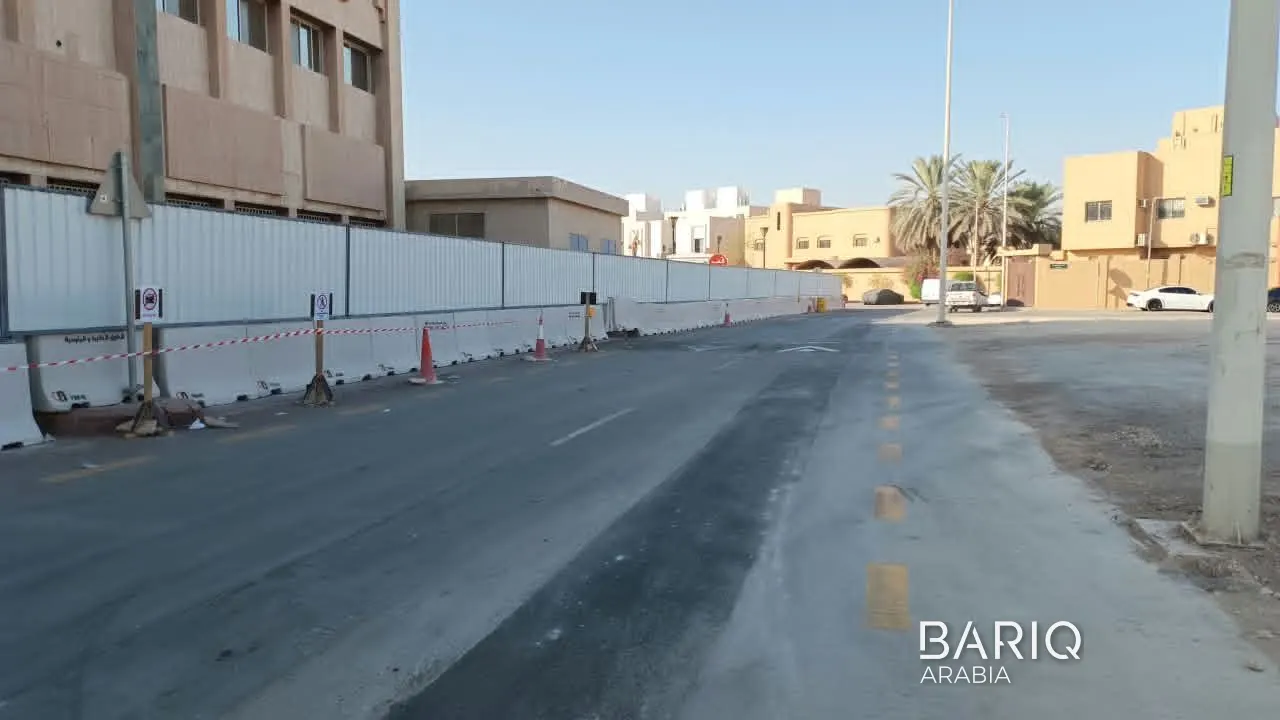
“Shinko” is the common Saudi name for corrugated metal sheet, galvanised steel or aluminium, usually painted white. A shinko fence is made of these sheets bolted to horizontal rails and steel posts, with triangular braces inside the site on long or tall frontages.
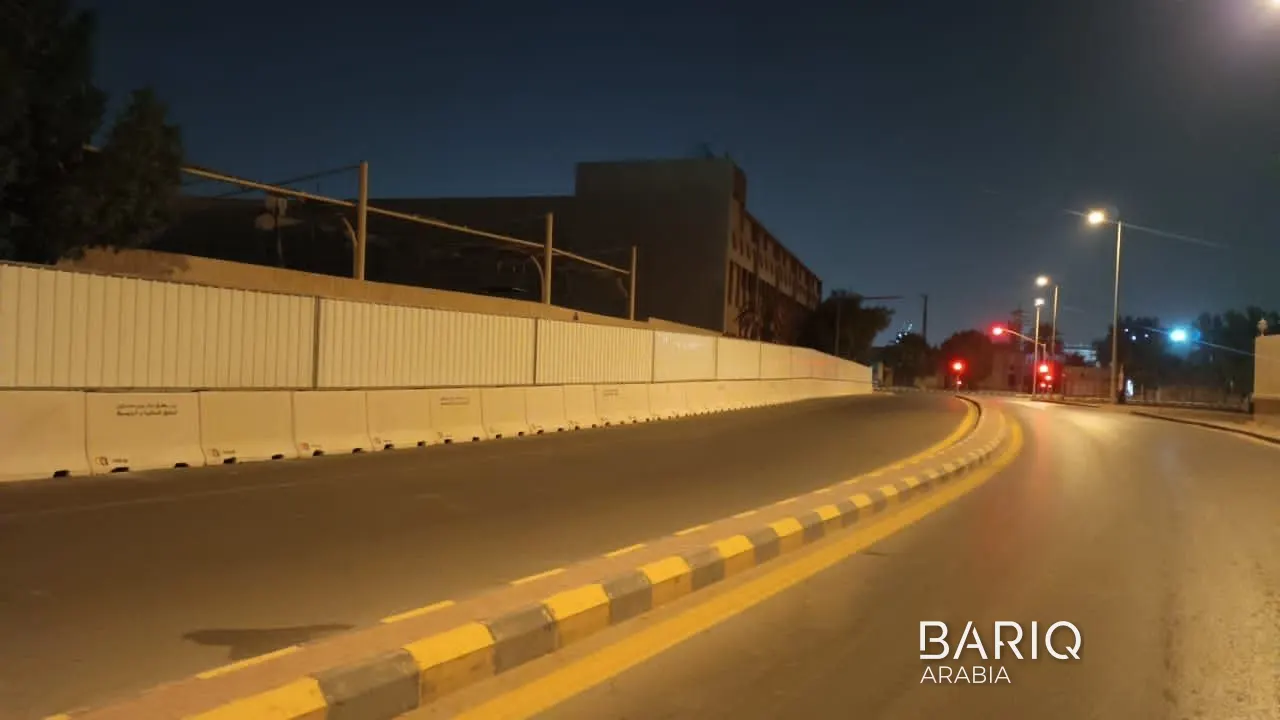
It is used in two settings: around building sites, where it is the fence itself, and on road projects, where it is often mounted on top of concrete New Jersey barriers to screen the works from the road, as in the photo.
Is shinko allowed as a construction-site fence?
In most cases, yes, but the permitted material depends on the project type and the street width, under the construction-site fencing guide:
- Residential projects: corrugated aluminium or similar materials, in a uniform white with identical panel sizes, with no more than 15 cm between strips.
- Commercial projects on streets 40 m wide or less: corrugated aluminium in a uniform white with identical sizes is allowed, with 15 cm between strips.
- Commercial projects on streets wider than 40 m: the fence is timber or weather-resistant metal or similar, executed to a distinctive design and covered with the project perspective. Plain white shinko is usually not enough here; printed panels are the better fit.
- In every case: concrete barriers, wire mesh and fabric screens are not accepted as a construction-site fence.
- Permanent fencing of vacant land is a different matter, with its own Balady licence and approved models in the unified vacant-land fencing guide. We did not find solid shinko among those models, because the fence must let the land be seen from the street.
How high must a shinko fence be, and how far can it extend beyond the plot?
From the guide's table. A residential project over 1,500 m² follows the commercial rules for streets narrower than 40 m:
| Street | Fence height | Maximum extension beyond the plot |
|---|---|---|
| Residential, 10 m wide or less | At least 1.5 m | 2.5 m |
| Residential, wider than 10 m | At least 1.5 m | 3 m |
| Commercial, 40 m wide or less | 2 to 3 m | 2 m |
| Commercial, wider than 40 m | 2 to 7 m | 2 m |
Components and fixing
- Sheets: white corrugated steel or aluminium of a uniform size, bolted to the rails.
- Posts and rails: galvanised, rust-resistant steel tubes; the height and frontage length set how many and how far apart.
- Fixing on residential projects: aluminium bases or steel tubes fixed with removable bolts. Digging into the pavement or road, pouring concrete on it or weighting posts with stones is not allowed.
- Fixing on commercial projects: posts on concrete footings fixed from inside the site so wind does not affect the fence; the guide recommends an engineering office designs the footings.
- Bracing: triangular braces on the inside for tall or wind-exposed frontages.
- Gates: at least 3 m wide, opening inwards or sliding, and never locked during working hours.
- Safety and information: reflective guidance and warning signs, and a plastic or metal board with the site contact, permit number and the contractor's details including its commercial registration.
How we install shinko fencing
- Survey: we measure the frontages and fix the gate positions, the street type and its width.
- Agree the details: height, material, fixing and gates for the project type and street width.
- Fabrication: we make and paint the steel frames and gates at our Riyadh factory.
- Installation: our crew installs the fence around the site, by day or at night depending on traffic, with the warning signs and the information board.
- Maintenance: we replace damaged sheets and re-tighten bolts and braces throughout the project.
- Dismantling, moving and removal: we take the fence down and move it as the work or traffic diversions progress, and remove it at the end.
White shinko, printed hoarding or fencing on barriers?
| Type | Suits | Notes |
|---|---|---|
| White shinko on a steel frame | Residential projects, and commercial projects on streets 40 m wide or less | Fastest to install; can be dismantled and reinstalled |
| Printed panels with the project identity | Commercial projects on streets wider than 40 m, and developer projects | Must be covered with the project perspective on streets wider than 40 m |
| Shinko or panels on New Jersey barriers | Road projects and traffic diversions | The barrier separates traffic, the fence screens the works, and both move together |
What drives the cost of shinko fencing?
That is why we do not quote a single price per metre before we have these details. Send us photos and measurements and we'll reply with a preliminary estimate within 24 hours; site surveys are free.
- Frontage length and the number of corners.
- The required height, set by the project type and street width.
- Number and width of gates.
- Fixing: bolted removable bases or concrete footings inside the site.
- Triangular braces on tall or wind-exposed frontages.
- Printing or lighting, if you need them.
- How long the fence stays up, maintenance, and how many times it is dismantled and moved.
- Site access, and night work beside live traffic.
Does a shinko fence need a permit? What is the fine for no fence?
We found no separate Balady service for a temporary construction-site fence permit: the guide ties the fence to the building permit, so it stands as long as the permit does and is renewed with it. If the fence extends beyond the plot boundary, the licence is for one renewable year, up to 5 years from the building permit date, with pavement occupation fees under the municipal services fee schedule.
Under the penalties schedule updated in March 2026, in Riyadh: SAR 2,000 for a building site without a temporary fence, and SAR 1,000 each for not meeting the fence height, a non-compliant fence, a damaged fence and a missing permit information board.
Full Saudi site hoarding rules with the fines tableOur shinko fencing projects in Riyadh
- White shinko fencing with triangular braces for a Nesma project on Prince Turki Road.
- Dirab Road development: shinko on steel frames with printed panels, together with New Jersey barriers.
- Prince Turki Al Awwal Road diversions: frames dismantled and moved with every diversion.